
Mattress names now carry their spring count like an engine size: 2000, 4000, 7000. It is easy to assume more springs means more support. Often it does not. Past a certain point, extra springs are tiny ones layered on top, there to grow the number rather than hold you up.
Two kinds of spring hide inside one number
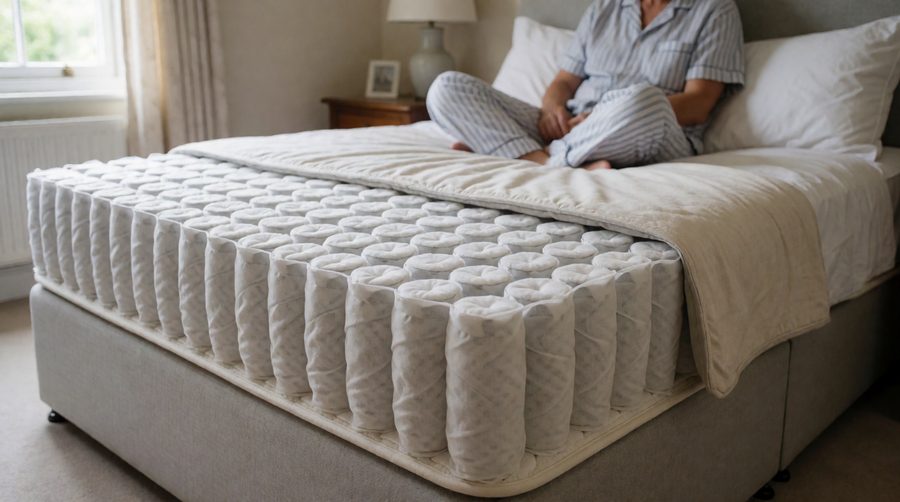
A pocket sprung mattress wraps each coil in its own fabric pocket, so it moves on its own. That part is genuinely useful. The trick is in what gets counted.
- Full-height pocket springs form the support core. These hold your spine level and stop the hips sinking too far.
- Mini or micro springs are short coils, a few centimetres tall, packed in a thin sheet above the core. They add a little responsive comfort, but they have very little travel.
Industry experts point out that counts above roughly 3,000 are almost always reached by adding layers of mini springs. A mattress with 1,000 full-height springs and 6,000 minis is sold as a “7000”.
Real headline counts, split open
Several mattresses we list publish the breakdown. Here is what the big numbers are made of. Counts are for a double unless stated.
| Headline count | Full-height springs | Mini springs | Share that is mini |
|---|---|---|---|
| 7,000 | 1,000 | 6,000 | 86% |
| 4,600 | 1,600 | 3,000 | 65% |
| 3,750 | 1,250 | 2,500 | 67% |
| 2,750 | 1,250 | 1,500 | 55% |
| 2,050 | 1,050 | 1,000 | 49% |
Swipe the table sideways to see every column.
Look at the second column. The supporting core of all five sits between 1,000 and 1,600 springs. The headline ranges from 2,050 to 7,000. The gap is almost all minis.
Ask for the split. If a listing only gives one number, the retailer's specification tab or the manufacturer's site often shows the full-height count. That is the figure to compare between mattresses.
Spring counts change with the size
A spring count is usually quoted for one size, normally a double or a king. A single of the same model has fewer springs, and a super king has more. Comparing a “1,500 spring” king with a “1,200 spring” double tells you nothing.
For most people, UK specialists put the useful range at 800 to 2,000 full pocket springs in a king. Beyond that you are mostly paying for marketing rather than comfort you can feel.
What matters more for side sleepers
For a side sleeper the springs are the foundation, not the cushion. What decides whether your shoulder hurts is what sits on top of them. Rank the specs like this:
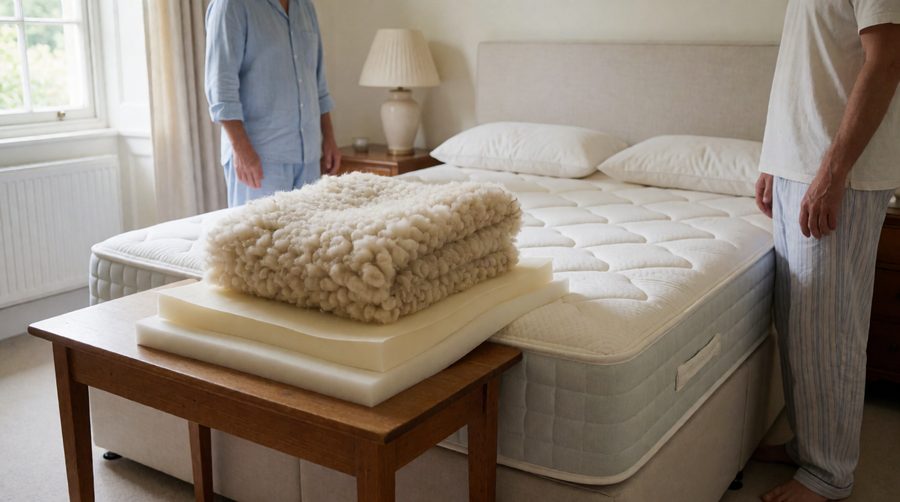
- The comfort layers. Depth and type of foam, latex, gel or wool above the springs. This is where the shoulder sinks. Our guide to the dead arm problem explains why at least 5cm matters.
- The firmness options. A great spring unit is no use if the softest version is firm. See how to read firmness labels.
- Zoning. Some units are softer under the shoulders and firmer under the hips. That suits side sleepers well.
- Edge support. Firmer springs round the edge stop you rolling off and make the whole width usable.
- The spring count. Last, and only the full-height figure.
Other spring terms you will see
| Term | What it means | Worth paying for? |
|---|---|---|
| Nested springs | Springs staggered so they sit in the gaps of the next row, not in straight lines | Yes – more support from the same space |
| 8-turn or 10-turn springs | More coils in each spring, so it responds more gradually to weight | Yes, on premium natural mattresses |
| Dual or triple layer | Mini springs stacked above full-height springs | Some comfort benefit, but inflates the count |
| Open coil | Springs joined together, so they move as one | Cheaper, but more partner disturbance |
| Zoned | Different spring tension under shoulders and hips | Yes, for side sleepers |
Swipe the table sideways to see every column.
Where springs do earn their place: sharing a bed
Side sleepers shift more than most. Every time you roll from one side to the other, the mattress moves. If you share a bed, that matters.
- Pocket springs move one at a time, so your turn stays on your side of the bed.
- Open coil springs are wired together, so movement travels across the mattress to your partner.
- A firm edge lets you both use the full width instead of rolling towards the middle.
So for couples, choose pocket springs over open coil every time. But a well-made 1,000-spring pocket unit already isolates movement well. Paying extra for 4,000 or 7,000 will not make your partner's restless nights noticeably quieter.
If you and your partner need different firmness, a zip and link mattress does more than any spring count. It is two mattresses joined together, each in its own firmness.
Do more springs last longer?
Not on their own. Long life comes from good springs plus comfort layers that resist settling. The layers sag first, and side sleepers feel it first, as a dip under the hip. Our guide to hip dips and guarantee claims covers what is normal and when you can claim.
Key points
- Big spring counts are mostly mini springs layered over a normal support core.
- Compare the full-height spring count, and only between the same mattress size.
- 800–2,000 full pocket springs in a king covers most people's needs.
- For side sleepers, comfort layers and firmness options matter more than springs.
- Nested, zoned and multi-turn springs are worth paying for. Big headline numbers are not.
Sources
Read next
Ready to compare?
Filter every mattress we list by firmness, size, depth, springs, cooling and guarantee — ranked for side sleepers.
Use the mattress finder