
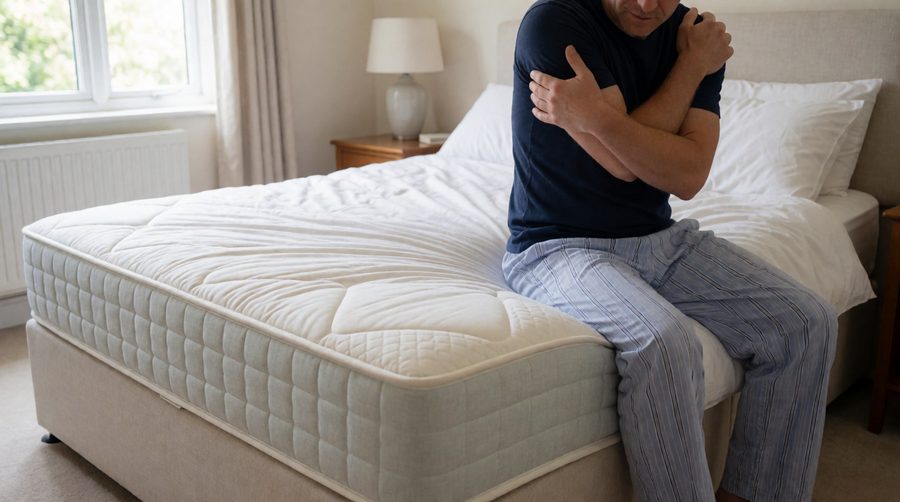
If you wake up shaking pins and needles out of one arm, or your shoulder aches before you have even got out of bed, the mattress is the first thing to suspect. On your side, one shoulder and one hip carry most of your weight on a strip of mattress a few centimetres wide. If that strip will not give, something in the shoulder has to.
What is actually happening to your arm
Lie on your side and your shoulder is the widest point of your body. On a surface that is too firm, it stays proud of the mattress instead of sinking in. Your whole upper body then balances on the point of that shoulder.
Two things follow, hour after hour:
- Blood flow through small vessels drops. That is the tingling, heavy, dead-arm feeling you wake up shaking out.
- The rotator cuff is squashed. The tendons around the joint sit under steady load all night, which is why the ache can last into the morning.
There is a knock-on effect too. With the shoulder held up, your neck and upper spine bend down towards the mattress. Many side sleepers blame the pillow when the real fault is underneath it.
The signs your mattress is too firm for side sleeping
Run through these. Two or more usually means the surface is fighting you:
- A numb or tingling arm on whichever side you sleep on.
- Shoulder or hip aches that are worse on waking than at bedtime.
- You turn over many times a night, chasing a comfortable spot.
- Lying on your side, your waist does not touch the mattress. There is a gap you could slide a hand through.
- You have started sleeping with your lower arm under the pillow to prop your head up.
That last one is a habit many people do not notice. It builds the missing height under your head, but it puts the arm you are lying on under even more pressure.
The firmness that fixes it
Testers who rate mattresses on a 1–10 firmness scale put most side sleepers between 4 and 6: medium-soft to medium. That range lets the shoulder and hip sink in while the waist stays supported, so the spine runs in a straight line.
Body weight moves the target. A heavier body sinks further into the same mattress, so it needs more resistance to stop the hips dropping too far.
| Your weight | Firmness to look for | 1–10 scale | What goes wrong if it is wrong |
|---|---|---|---|
| Under 9 stone (57kg) | Soft to medium-soft | 3–4 | Too firm: you never sink in, and shoulder pressure builds fast |
| 9 to 16 stone (57–102kg) | Medium | 5–6 | Too soft: hips sag. Too firm: dead arm |
| Over 16 stone (102kg) | Medium-firm | 6–7 | Too soft: you bottom out through the comfort layer |
Swipe the table sideways to see every column.
The catch is that these numbers only help if brands use the same scale, and they do not. One maker's medium is another's firm. Our guide to reading firmness labels as a side sleeper shows how to see past the label.
It is the top few centimetres that matter
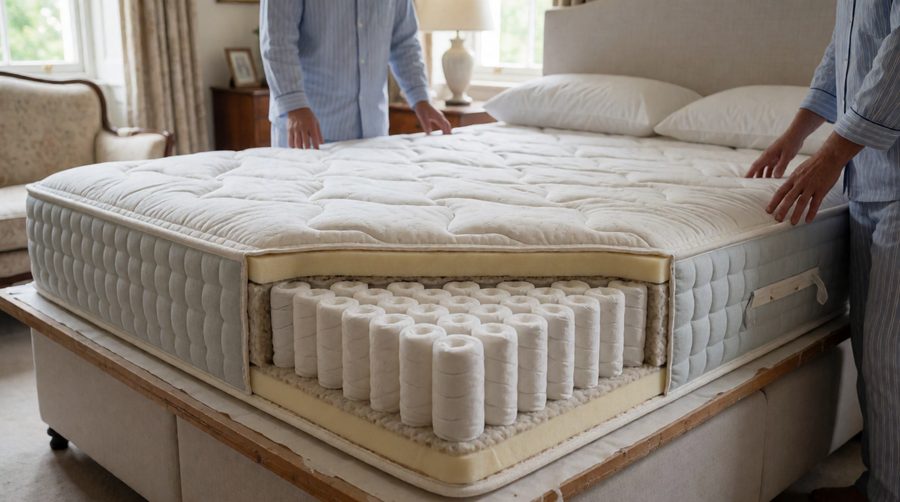
The shoulder only presses a few centimetres into a mattress. What sits in those centimetres decides whether it feels cushioned or blocked. Look for at least 5cm of genuine comfort material — memory foam, latex, gel foam or deep wool — above the springs.
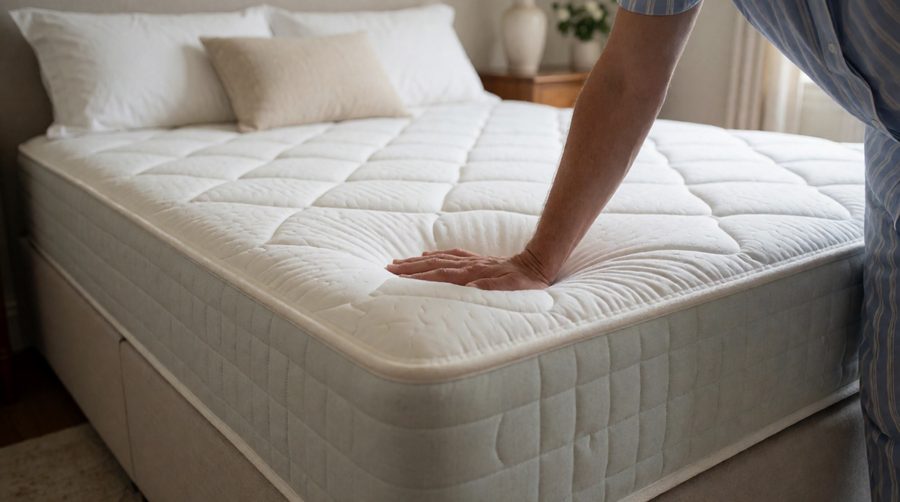
This is why a headline spring count tells you so little. A mattress can boast thousands of springs and still have a thin, hard top. Our guide to what spring counts really mean explains which numbers are worth paying for.
Already own a firm mattress? A 5–8cm memory foam or latex topper adds cushioning exactly where the shoulder lands. It is a fraction of the cost of a new mattress and often enough to end the dead arm.
Check your pillow height too
Once the shoulder sinks properly, your head sits lower. A pillow that was right on a hard mattress can now be too tall. The gap to fill is roughly the distance from your neck to the edge of your shoulder.
- Your nose should line up with the centre of your chest.
- If your head tilts up towards the ceiling, the pillow is too high.
- If you still reach for the arm-under-pillow position, it is too low.
How long to give a new mattress
Your body needs time to adjust, and so does the mattress. Comfort layers soften noticeably over the first few weeks. Give it about 30 nights before you decide.
That timing matters because comfort trials have rules and fees. Before you buy, read what a 40-night comfort trial really costs, so you know how long you have and what changing your mind will set you back.
See a GP if the numbness lasts. Tingling that fades within minutes of waking is pressure. Numbness that lingers through the day, or weakness in the hand, needs a medical check.
Key points
- A dead arm comes from your shoulder carrying your upper body on a surface that will not let it sink.
- Most side sleepers suit 4–6 on a 1–10 firmness scale. Heavier sleepers go a notch firmer.
- A gap under your waist when lying on your side is the easiest sign a mattress is too firm.
- Look for at least 5cm of real comfort material above the springs.
- A 5–8cm topper can rescue a mattress that is too firm.
- Give any new mattress about 30 nights before you judge it.
Sources
Read next

Ready to compare?
Filter every mattress we list by firmness, size, depth, springs, cooling and guarantee — ranked for side sleepers.
Use the mattress finder