
Firmness is the single biggest decision for a side sleeper, and it is the one the labels help with least. There is no UK standard for what soft, medium or firm means. Each maker sets its own scale, tests its own way and picks its own words.
Why the labels do not line up
A label describes how the mattress feels against that brand's own range. It says nothing about how it compares with anyone else's. Walk round a showroom and you can find a “medium” that feels plush beside a “medium” that feels like a gym mat.
The systems you will meet include:
- Words – soft, medium, firm, extra firm, with medium-soft and medium-firm in between.
- Numbers – a 1–10 scale, where some brands call 6 medium and others call it firm.
- H-ratings – H2, H3, H4, borrowed from European makers. They are a guide to body weight, not a measured standard.
- Made-up names – “plush”, “orthopaedic”, “luxury firm”. These are marketing words with no fixed meaning.
“Orthopaedic” usually just means firm. It is not a medical standard. For a side sleeper, an orthopaedic mattress is often the wrong choice, because firmness is what causes shoulder pressure in the first place.
The same word, different feel: real examples
The mattresses we list show the problem. Here is how a handful of real ranges label their softest option against how that option behaves for a side sleeper.
| Mattress type | Softest option sold | Our 1–10 rating | Side sleeper verdict |
|---|---|---|---|
| Graphene foam hybrid, 34cm | Soft | 3 | Good for lighter and average builds |
| Natural latex and wool, pocket sprung | Medium | 5 | Good for most builds |
| Zoned foam spring hybrid, 22cm | Medium firm | 6 | Average to heavier builds only |
| Conical spring hybrid, 25cm | Medium to firm | 6 | Average to heavier builds only |
| Graphite latex, dual-layer springs | Firm | 7 | Too firm for most side sleepers |
Swipe the table sideways to see every column.
Notice that “medium firm” and “medium to firm” land in the same place. And a range whose softest option is “firm” simply has no side-sleeper version, however good the rest of it is.
Use your body weight, not the label
The same mattress feels softer under a heavier person, because they press deeper into the comfort layers. So the right label depends on you as much as the mattress.
- Lighter builds barely compress a firm surface. Go for soft or medium-soft.
- Average builds are best served by medium.
- Heavier builds sink further, so medium-firm stops the hips dropping out of line.
Our guide to why side sleepers wake with a dead arm has the full weight-by-weight table.
Read the materials instead
Because the label is unreliable, look at what the mattress is made of. Two things decide how a side sleeper feels on it.
- The depth and type of the top layer. Memory foam, latex, gel foam or thick wool above the springs lets the shoulder sink. A thin quilted top over springs does not.
- Whether the softer options exist. A range sold in soft, medium and firm lets you match your weight. A range sold in firm only does not.
Spring numbers tell you less than you would expect. Our guide to what spring counts really mean shows why.
The two-minute test that beats any label
If you can try a mattress, skip the quick sit on the edge. Do this instead:
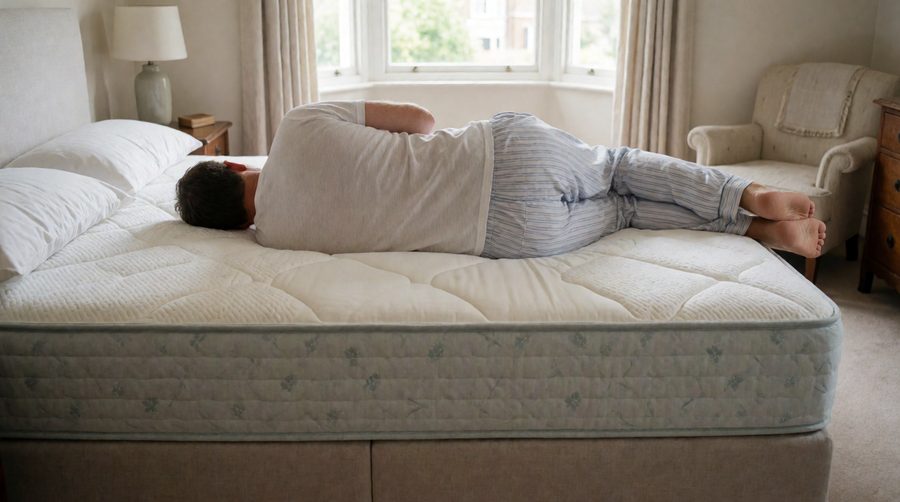
- Lie on your side in your normal sleeping position for at least five minutes. Take your coat off.
- Slide a flat hand under your waist. If it goes in easily, the mattress is too firm for you.
- Ask someone to look at you from the foot of the bed. Your spine should run in a straight line from your neck to your hips.
- Notice your shoulder. Any pressure within five minutes will be far worse after five hours.
Buying online? You cannot do the test first, so your real test is the comfort trial. Check how many nights you get, and what swapping costs, before you order. Our guide to the 40-night comfort trial covers the fees.
When you are torn between two
Side sleepers caught between medium and medium-firm should usually go softer. A slightly soft mattress can be firmed up a little with a firmer base. A mattress that is too firm can only be fixed with a topper, and the dead arm comes first.
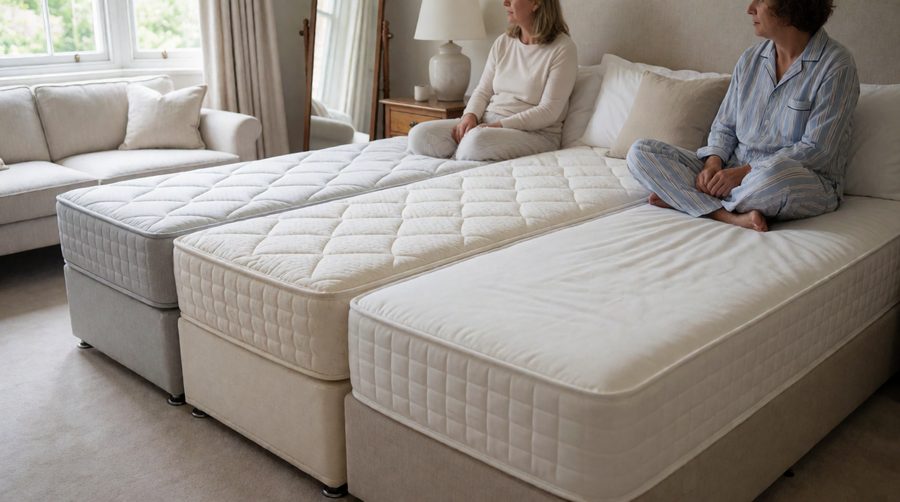
The exception is if you share the bed with a heavier partner or a back sleeper. A zip and link mattress lets each side have a different firmness, so neither of you has to compromise.
Key points
- There is no UK firmness standard. Labels only compare a mattress with its own range.
- “Orthopaedic” usually means firm, which rarely suits side sleepers.
- Choose by body weight: lighter go soft, average go medium, heavier go medium-firm.
- Judge the top comfort layer, not the label or the spring count.
- Test on your side for five minutes and check for a gap under your waist.
- If torn between two, a side sleeper should usually pick the softer one.
Sources
Read next
Ready to compare?
Filter every mattress we list by firmness, size, depth, springs, cooling and guarantee — ranked for side sleepers.
Use the mattress finder